
 USA
USA
 AUS
AUS
 EU
EU


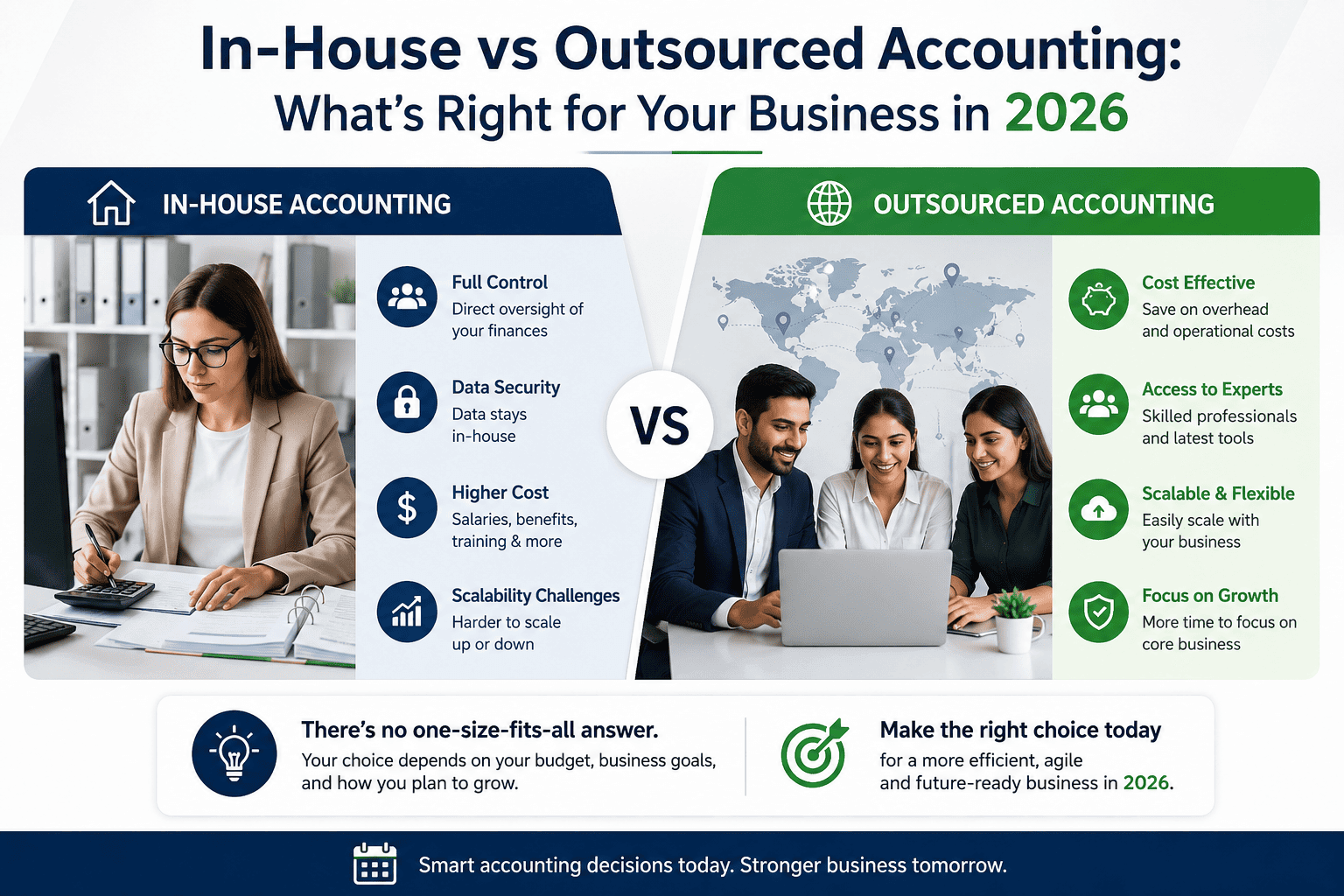
In-House vs Outsourced Accounting: What’s Right for Your Business in 2026?
Managing finances is one of the most critical and time-consuming aspects of running a business. Whether you are a growing startup or an established firm, the decision between keeping accounting in-house or outsourcing it to experts can define your operational efficiency, cost structure, and long-term growth.
In this guide, we break down both models, highlight their real-world advantages and limitations, and help you make the smartest choice for your business.
What Is In-House Accounting?
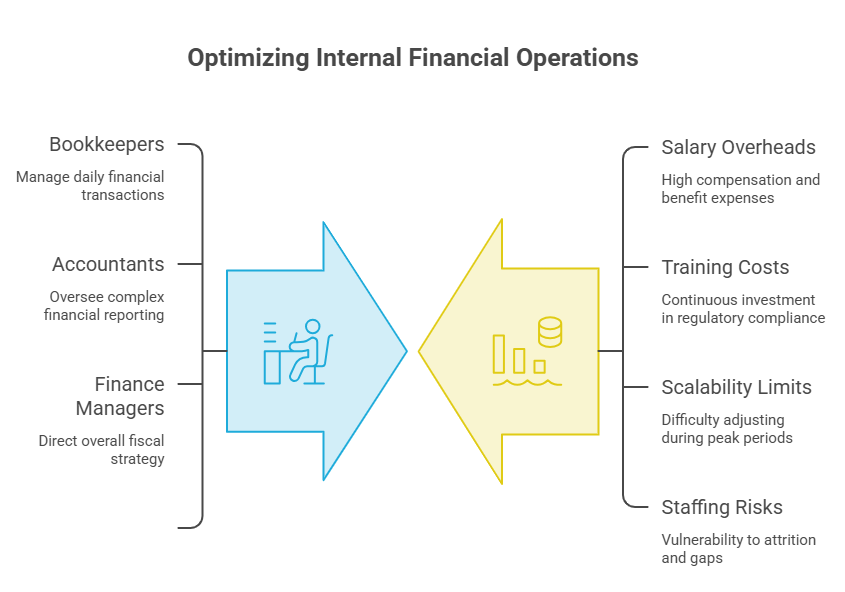
In-house accounting means hiring internal staff bookkeepers, accountants, and finance managers to handle your financial operations. This includes managing accounts payable and receivable, payroll processing, tax compliance, and financial reporting.
The key benefit? You have direct control. Your team is on-site, understands your business culture, and can respond immediately to internal queries.
However, in-house accounting comes with significant challenges:
- High salary and benefits overheads
- Ongoing training costs as tax laws evolve
- Limited scalability during peak periods
- Risk of skill gaps and staff attrition
What Is Outsourced Accounting?
Outsourced accounting involves partnering with a specialist third-party provider to manage your financial functions. Services typically include bookkeeping, payroll, tax preparation, financial reporting, and year-end accounts.
Explore our outsourced bookkeeping services and payroll outsourcing solutions to see how we support businesses at every stage.
Key Benefits of Outsourcing Accounting
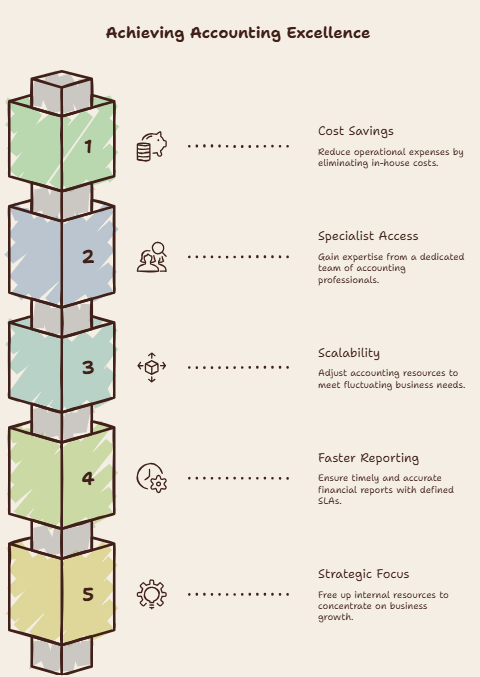
1. Cost Savings of 40–60%
Outsourcing eliminates salary costs, employee benefits, office infrastructure, and technology licensing fees. Businesses that outsource accounting functions typically save between 40% and 60% on operational costs compared to maintaining a full in-house team.
2. Access to a Full Team of Specialists
Rather than relying on one or two internal accountants, outsourcing connects you with a dedicated team from junior bookkeepers to senior accountants and quality assurance professionals all working together on your account.
Learn more about our accounting outsourcing services and the expertise we bring to every engagement.
3. Scalability and Flexibility
Your business needs fluctuate. Outsourcing allows you to scale up during tax season or year-end and scale down during quieter periods — without the burden of managing headcount.
See our flexible pricing plans designed to match your workload, not a fixed headcount.
4. Faster Turnaround and Real-Time Reporting
Outsourced accounting teams operate with defined SLAs, ensuring timely month-end closings, accurate reconciliations, and on-demand financial reporting. With global delivery models, many providers offer near-round-the-clock support.
Discover how our financial reporting services keep your business informed and compliant at all times.
5. Focus on Strategic Growth
When financial administration is handled externally, your internal leadership can focus on what matters most — growing revenue, serving clients, and building advisory capabilities. Studies show that nearly 61% of business owners look to their accountant as a primary source of business advice. Outsourcing the transactional load gives your accountants the bandwidth to deliver real strategic value.
In-House vs Outsourced: A Quick Comparison
Control: In-house teams offer direct oversight; outsourcing provides governance through SLAs and reporting.
Cost: In-house carries fixed overhead; outsourcing is variable and scalable.
Expertise: In-house is limited to hired staff; outsourcing gives access to a full specialist team.
Scalability: In-house requires new hires; outsourcing scales on demand.
Technology: In-house requires investment; outsourcing providers stay updated at no extra cost.
When Does Outsourcing Make the Most Sense?
- Your business is scaling and in-house capacity is stretched
- You are struggling to recruit or retain qualified finance professionals
- Tax compliance demands are growing more complex
- You want access to real-time financial reporting without the overhead
- You need to reduce costs without compromising quality
Visit our home page to explore how we help businesses transition from operational chaos to financial clarity.
Outbound Resources
For further reading on accounting industry trends, visit the or explore guidance from the IFAC (International Federation of Accountants).
Final Thoughts
The in-house vs outsourced accounting debate is not about choosing the cheapest option —it is about choosing the smartest one. For businesses looking to grow efficiently, reduce risk, and gain access to deep financial expertise, outsourcing is increasingly the strategic choice.
Ready to explore your options? Contact our team today and let us build a solution tailored to your business.
Frequently Asked Questions
What is the difference between in-house and outsourced accounting?
In-house accounting means hiring internal staff to manage your financial operations directly. Outsourced accounting involves partnering with a specialist third-party provider to handle functions like bookkeeping, payroll, and financial reporting typically at a lower cost and with access to a broader range of expertise.
How much can a business save by outsourcing accounting?
Businesses typically save 40%–60% on operational costs. View our pricing plans to see how our engagement models are structured for different business sizes.
Is outsourced accounting safe and secure?
Yes. Reputable providers operate under strict data security protocols and confidentiality agreements. Contact our team to learn about our data security practices.
What accounting services can be outsourced?
Most financial functions can be outsourced, including bookkeeping, payroll processing, accounts payable and receivable, tax preparation, financial reporting, year-end accounts, and management accounts.
Is outsourcing accounting more cost-effective than hiring in-house staff?
In many cases, yes. Outsourcing eliminates expenses associated with recruitment, employee benefits, training, office infrastructure, and software licenses while providing access to experienced professionals.
When should a business consider outsourcing its accounting?
Outsourcing makes the most sense when your business is scaling rapidly, struggling to recruit qualified accountants, facing complex compliance requirements, or looking to reduce overhead costs without compromising on financial accuracy.